

Uptime Is Not Runtime: The Work-to-Charge Ratio for High-Throughput AMRs and Humanoids
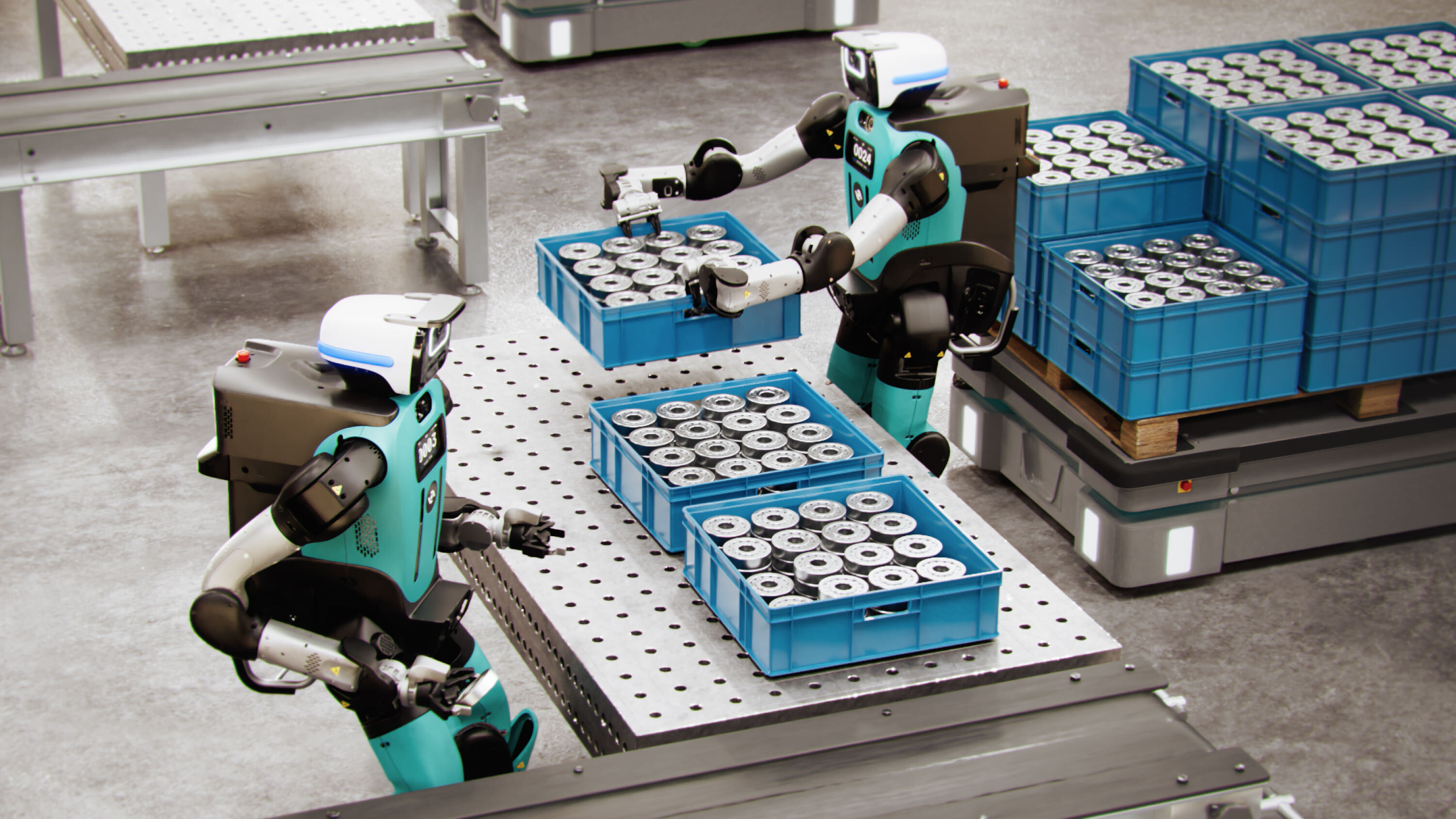
In a growing fraction of the mobile robot application space, the commercial model is shifting towards the customer paying for actual work accomplished rather than paying for the robot. That shift has major implications for battery selection.
If a robot works two or three shifts a day, whether in order fulfilment, tote handling or automotive intralogistics, every minute it spends charging is a minute it isn’t earning.
Interact Analysis forecasts that order-fulfilment robots will make up around half of all mobile robot shipments by 2030 [1]. Amazon alone now runs more than one million robots across its fulfilment network [2]. GXO’s deployment of Agility Robotics’ Digit runs on a multi-year Robots-as-a-Service contract, where the customer pays for work done rather than for the machine [3]. Under that model, charging downtime stops being the customer’s problem. It becomes the robot maker’s.
Runtime vs uptime
Uptime is the share of a shift the robot is available to work.
A robot with a long runtime but a slow recharge for its battery can easily end up delivering significantly worse uptime (work that is paid for by a warehouse operator) than one with a shorter runtime and Instant Charging. Runtime is a battery specific property. Uptime is what you get paid to deliver. Uptime is an operational outcome, and in a 20-hour operation it is the one your customer measures you on.
The work-to-charge ratio
The simplest way to compare approaches is examine how quickly a robot gets back to work, and what it carries to make that possible.
| Approach | Runtime | Back to work in | Uptime (excl. transit) | What it costs in space |
| Agility Digit with Nyobolt | ~90 min | <9 min recharge | ~91% | One compact pack, charged in place |
| Illustrative conventional Li-ion | 120 min | 60 min recharge | 67% | Larger pack in the robot, plus spare robots on the floor |
| Battery swapping (UBTech Walker S2, published figures) | ~2 h walking | ~3 min swap | Highest headline figure | Two battery bays in the robot, spare packs and swap stations on the floor; each pack takes ~90 min to recharge |
Swapping posts a strong uptime figure but with several well-known downsides. Nevertheless, the appeal of battery swapping signals an important point worth taking seriously, because it shows the industry already accepts that a full-shift battery is the wrong answer for high-volume work. The question is what each route costs in volume, inside the robot and on the floor.
Why chasing runtime costs space
The default approach for non-stop robot operation is just fit out the robot with a bigger battery. In an 8-hour single-shift application, that can work, using overnight charging. In a two- or three-shift operation it doesn’t. The battery would have to be two to three times as large to deliver that extra service, which is a major cost and weight burden at a minimum and takes two to three times as long to recharge. Depending on power requirements for the robot, the battery can become larger than the robot!
Meanwhile, every extra cell added to a humanoid or AMR device takes volume and mass away from payload, actuators, sensors and compute. A heavier robot needs more energy to move, which erodes the runtime the larger pack was meant to deliver.
The other workarounds people have explored include spare robots and swap stations, both of which take floor space in facilities where floor space is the asset being optimised; one charging vendor estimates conventional fleets are inflated by 20–25% to cover charging downtime [4]. Swapping also puts a second battery bay inside the robot and keeps packs in circulation that need around 90 minutes each to recharge [5]. A larger inventory of batteries is needed because every robot has a battery, plus spare batteries are always charging.
Power density changes the sizing logic
For a given robot and duty cycle, battery energy density determines how long a pack lasts. Power density determines how fast it can deliver (on discharge) and accept (i.e., charge) power. Nyobolt’s cells are engineered for the second, providing the holy grail to highest levels of performance and efficiency.
High-volume workflows in warehouses are full of short, predictable pauses: a tote handoff, a conveyor wait, a queue at induction. When a pack recharges in minutes, and during pauses, it no longer needs to be sized to survive a full shift. It needs to bridge the gap between those pauses. The result is a smaller pack, more usable space inside the robot and for payload, and higher uptime than a larger battery would deliver.
Symbotic’s SymBot shows what that looks like at production scale: its Nyobolt pack is 40% lighter and offers 10x the cycle life of the ultracapacitors it replaced [6].
Cycle life matters more here than anywhere else. A robot charging every 90 minutes across a 20-hour operating day sees a dozen or more charge events a day and over 4,000 a year. A chemistry that degrades under that duty cycle will quietly take uptime back over the life of the fleet.
Four questions to put to your battery supplier
- What is the charge time to usable state of charge, and at what C-rate? Saying you have “Fast charging” without specifying a time for a complete charge is not a specification.
- Does the charge rate hold at your duty cycle? Ask for data at thousands of cycles a year, not a new-pack figure.
- What is real uptime across your customer’s shift pattern? Including transit and queueing at chargers. Ask for a duty-cycle figure, not a datasheet one.
- How much volume does the pack take to deliver that uptime? And what could the rest of the robot do with extra space.
The right comparison is not how long a robot runs. It is how much of the shift it works.
Sources
- Interact Analysis, Mobile Robots report, January 2026 (via Control Engineering / Supply & Demand Chain Executive).
- Amazon, 1 millionth robot announcement, July 2025 (via TechCrunch).
- Agility Robotics and GXO, multi-year RaaS agreement (via Robotics 24/7 / The Robot Report).
- CaPow, “8 Cutting-Edge Trends in Autonomous Mobile Robots” (vendor estimate).
- UBTech Walker S2 specifications (via CnEVPost, AI Business, Robotics 24/7).
- Nyobolt / Symbotic SymBot deployment data.
Stay Updated with Nyobolt Insights
Subscribe to our free newsletter
